
Known for his surreal, yet mathematical drawings and lithos, the Dutch artist is remembered in a remote Italian town.
Maurits Cornelis Escher
Maurits Cornelis Escher aka M.C. Escher was a Dutch artist. He was a genius in the use of perspective and mathematics, specifically geometry, to create works that defied logic and the physical world.
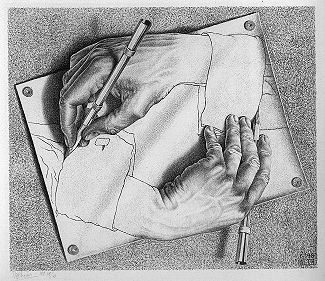
Some of his most famous pieces are “Maos Desenhando,” the hand drawing the other hand, and “Relativity,” where stairs are neither up nor down and humans don’t obey the laws of physics.
Escher traveled extensively and lived in Rome from 1923 to 1935. During this time, he visited Scanno, a little mountain town in the region of Abruzzo, traveling with a friend and using a donkey to carry their clothes and provisions.
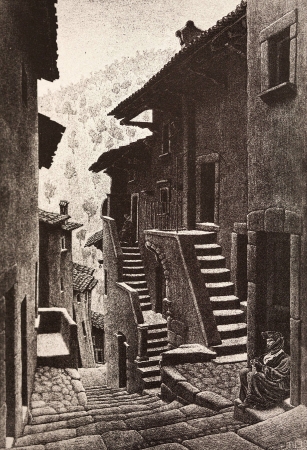
When Escher came upon the street of Vico Ciorla in Scanno, he must’ve been inspired by the staircase that vanishes downward while others connect the street level to homes. He created a lithograph called Strada di Scanno which captures the view perfectly.
At the location where the work is depicted, there is a small plaque commemorating Escher’s work.
Escher later visited other parts of Italy including the Amalfi Coast and Sicily, where the people influenced his work.
Escher hated fascism and the fanaticism it provoked. So, he left Italy in 1935, moving to Switzerland and Belgium before finally settling back in his home country of the Netherlands. M.C. Escher died in 1973.
About the Author

Brent Petersen is the Editor-in-Chief of Destination Eat Drink. He currently resides in Setubal, Portugal. Brent has written the novel “Truffle Hunt” (Eckhartz Press) and the short story collection “That Bird.” He’s also written dozens of foodie travel guides on Destination Eat Drink, including one to Scanno. Brent’s podcast, also called Destination Eat Drink, is available on all major podcasting platforms.