
A monk who built a following from a remote hermitage in Abruzzo, Italy was tabbed as pope in 1294. It didn’t go well.
Pope Celestine V origin story
The papacy of Celestine V is one of the most unusual in the history of Catholicism.
Pietro Angelerio was a monk in the 13th century. He lived a strict life of abstinence, poverty, and solitude. Around 1240, he arrived in Abruzzo, Italy and built a hermitage far up on the face of a mountain overlooking the town of Sulmona.
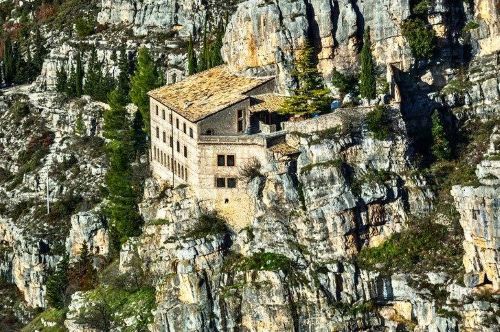
Despite the remoteness of the hermitage, Pietro attracted followers, later known as the Celestines, an order of Benedictines.
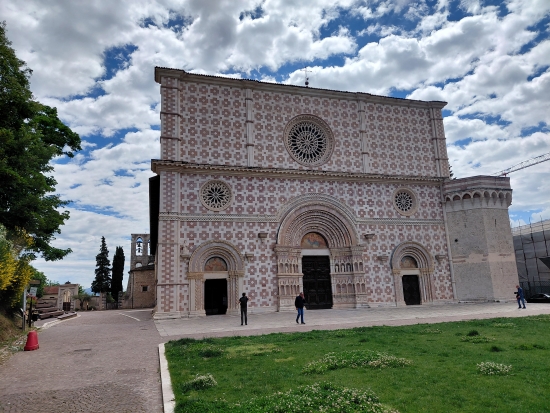
There is a legend that when Pietro visited nearby L’Aquila in 1274, he had a dream where the Virgin Mary asked him to build a church in her honor. In 1289 the Basilica di Santa Maria di Collemaggio, though unfinished, was consecrated.
That shows you how much sway Pietro held. He tells his followers about a dream and a massive church is built.
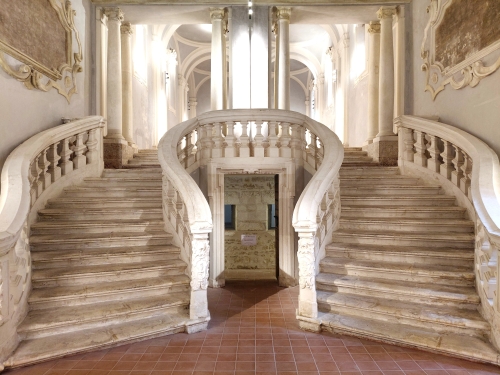
Closer to the hermitage in Sulmona, monk Pietro Angelerio’s followers built the Abbazia di Santo Spirito del Morrone, a monastery to house his ever growing following.
Rising to pope
After Pope Nicholas IV died in 1292, the Catholic church was in crisis. The cardinals were unable to reach consensus on a new pope, a drama that dragged on for two years. Finally, after Pietro sent a letter to the cardinals urging them to act, they surprisingly elected the reclusive monk as the new pope!
Pietro Angelerio was shocked at being tabbed for the post and was a little more than reluctant. He initially refused to accept the job until a group of cardinals and the King of Naples convinced him to become pontiff.
The monk took the name Celestine V and was crowned pope in 1294 in the place he had the dream about the Virgin Mary 20 years prior, Basilica di Santa Maria di Collemaggio. But, it wasn’t a happy ending for ol’ Celestine V. Being a monk from the hinterlands, he didn’t understand the inner workings or politics of the Vatican. Miserable in the job, he sent out a decree allowing popes to resign, which he did after only five months at the helm of the church.
Celestine’s intention was to return to his hermitage, but the next pontiff, Pope Boniface VIII, was concerned that Celestine would become an antipope and challenge his authority. So, Pope Boniface had Celestine arrested and imprisoned, where he died less than a year later.
Celestine was canonized as Saint Celestine in 1313.
Visiting the sites of Saint Celestine
Though he wasn’t pope for very long and his reign was marred by ineffectiveness and what some call poor leadership, Saint Celestine is revered in the region of L’Aquila where he lived and performed much of his work.
Eremo di Sant’Onofrio al Morrone
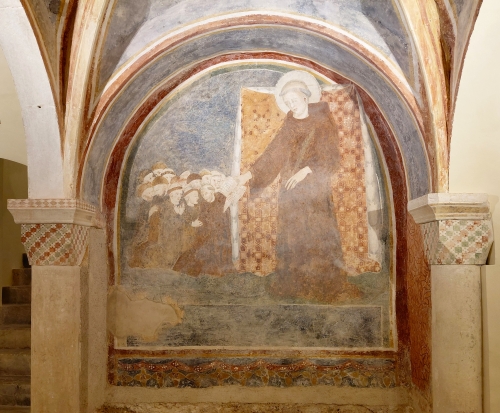
The hermitage, Eremo di Sant’Onofrio al Morrone, and church where the future pope lived is still standing and available to visit. The church has some deteriorating 15th century frescoes and a wooden ceiling, typical of churches in the area.
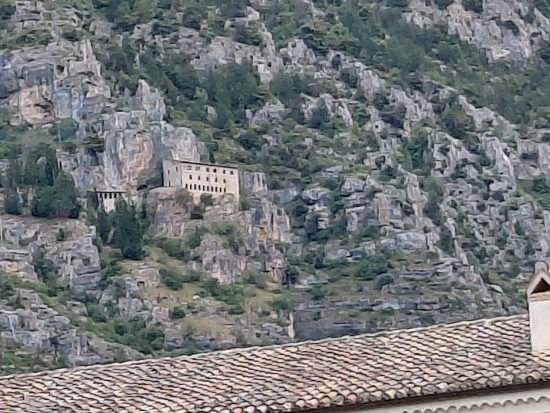
Operating hours are inconsistent and if it is overcast, the facility is almost always closed.
Abbazia di Santo Spirito del Morrone
Much easier to access is the Abbazia di Santo Spirito del Morrone.
After Celestine V died in 1294, his followers, called Celestines, carried on. The abbey was expanded several times but eventually was destroyed by an earthquake in 1706. The Celestines rebuilt the abbey in the current Baroque style.
However, the Celestines doggedness was no match for Napoleon. He outlawed religious orders and took over the abbey in the early 19th century. It was used as a college and later to house homeless people before it was turned into a prison. When the Nazis took over during WWII, the prison was a notorious site used for executing members of the Italian Resistance.
Today, the church still stands and there are some poorly preserved frescoes inside. There is also a museum and a short film you can watch about the history of the abbey. Several of the abbey buildings are dedicated to exhibitions and events as well as office space. Interestingly, one of the cloisters has a detailed exhibition outlining how the monks farmed the land with specific details on what they grew, what they ate, and the difficulties they had as they tried to sustain the order.
Basilica di Santa Maria di Collemaggio
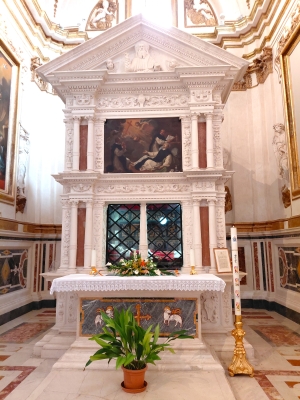
About an hour’s drive from the Hermitage and Abbey is the Basilica di Santa Maria di Collemaggio where Saint Celestine was crowned pope.
In 1461, an earthquake caused the dome to collapse, but it was restored. The 2009 earthquake also damaged the church. But, it has since been restored and the church reopened in 2017.
Celestine’s remains are kept in a tomb in the church. It is free to visit.
Getting here
L’Aquila is in the Abruzzo region of Italy. There is an airport in Pescara which has connecting flights to a few cities in Europe, but no direct flights to North America. Another option is to fly into Rome.
Rome is about 90 minutes by car to L’Aquila. The drive from Pescara is a little less. Be aware that L’Aquila is a very mountainous region. Driving can be hair-raising with lots of switchbacks and steep drop-offs.
The Basilica di Santa Maria di Collemaggio is in L’Aquila and the city is fairly easy to access by bus from Rome though there’s limited service from Pescara.
The hermitage and abbey, take a bit more work. A couple buses and a train go from Rome to Sulmona each day. There’s also a train from Pescara to Sulmona. From Sulmona, it’s 4 miles and the climb to the hermitage is tough. Best to take a taxi.
About the Author

Brent Petersen is the Editor-in-Chief of Destination Eat Drink. He currently resides in Setubal, Portugal. Brent has written the novel “Truffle Hunt” (Eckhartz Press) and the short story collection “That Bird.” He’s also written dozens of foodie travel guides on Destination Eat Drink, including several in Italy. Brent’s podcast, also called Destination Eat Drink, is available on all major podcasting platforms.